
01
Muscle gain
Hypertrophy6–12 reps on primary lifts, 65–80% of your estimated 1RM, 10–20 hard sets per muscle per week, deload every fourth week.
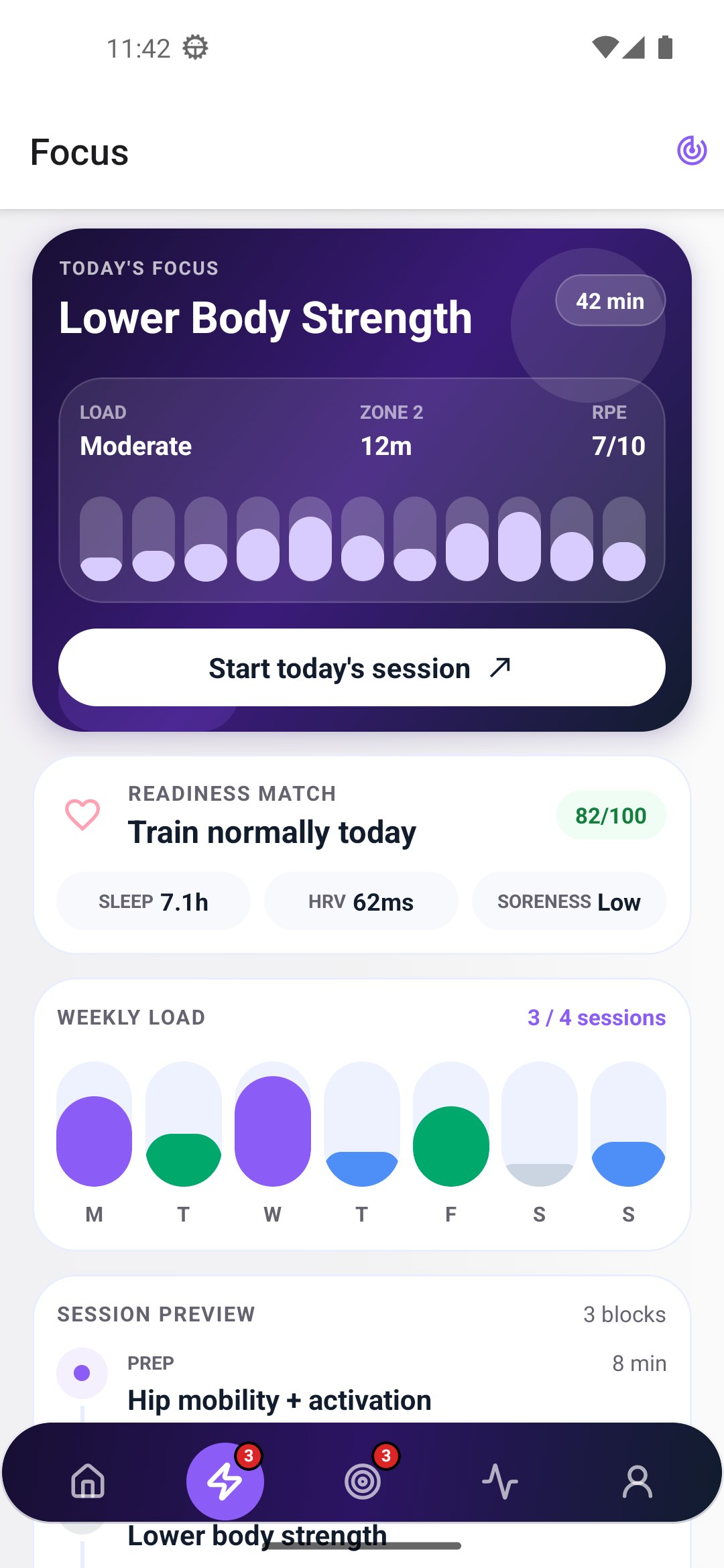
Build strength, aerobic fitness, and consistency with sessions shaped around your goal, equipment, and daily recovery.
Most fitness routines prescribe arbitrary splits that ignore nervous system fatigue, elevated inflammation (hs-CRP), or joint flare-ups.
Xcergy continuously evaluates your morning HRV, workout volume history, and clinical safety thresholds. Progression is earned through sustained physiological adaptations rather than ego-lifting into burnout.
Other apps count reps and streaks. Xcergy trains toward your metabolic health, the glucose, insulin, and blood pressure numbers that decide whether you actually feel stronger, or just more tired.
Answers the only morning question that matters: what exercises, intensity, and sets should I perform today to maximize longevity and performance?

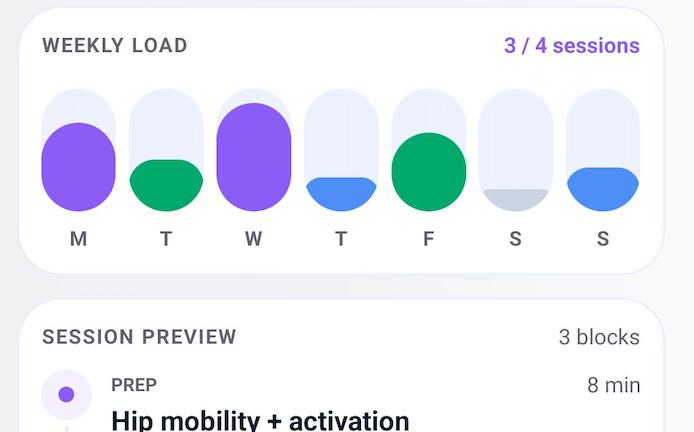
Periodized 4-week mesocycles. Dynamically modulated by sleep, readiness, and biomarker recovery.
Your full training split, rest intervals, equipment swaps, and real-time load logging live directly on your iPhone, guided by daily biomarker recovery.
Xcergy does not run one template at different weights. Your goal sets the split, rep range, intensity, and how progression is earned.
6–12 reps on primary lifts, 65–80% of your estimated 1RM, 10–20 hard sets per muscle per week, deload every fourth week.
10–15 reps, 55–70% of 1RM, Zone 2 three times a week, optional weekly high-intensity session, volume added before weight.
8–15 reps, Zone 2 twice a week, mobility included, progression reviewed every second week.
Most running in Zone 2 with a small hard fraction, two low-volume full-body strength sessions, weekly volume rising about ten percent.
Carries, get-ups, hinges and rotation, daily mobility, balance work, and movement quality before load.
Strength and Zone 2 carry the base. Mobility and steps keep the week repeatable. Readiness changes the dose before you open the session.
Hard weeks are hard on purpose. The easier week arrives before you need to earn it, so progression has room to hold.
Moderate volume, technique first. Establishing clean movement mechanics.
One more set per exercise. Steady volume progressive overload.
Volume held, working load and intensity step up.
Volume cut 40%, same exercises. Scheduled recovery before burning out.
Progression reads your logged sets, not the calendar. Load rises only when your recent average RPE sits at 8 or below, which is roughly two reps left in reserve, and only sessions from the last five weeks count toward that decision.
The size of the jump is set per movement, so a deadlift and a lateral raise do not move by the same amount. Zone 2 walks, mobility flows, yoga and breathwork have no load to add, so they progress in time instead.
You open the day's session and work through it: the movement, the target weight and reps, a rest timer that starts when you finish a set, and demo footage and coaching cues where you need them.
After each set you log the weight, the reps and how hard it felt. Effort is recorded on a 1-to-10 scale with the numbers spelled out: 7 is three reps left, 8 is two, 9 is one.
Readiness is built each morning from your HRV against your own 30-day baseline, your resting heart rate against your 7-day average, and your sleep. The session for that day is adjusted before you open it.
No movement is ever removed by a low score. One set stays, because keeping the pattern and the habit is most of the point on a bad day.
Zone 2 is defined as training below your first aerobic threshold, LT1. When your LT1 has been measured, your Zone 2 ceiling is known outright rather than estimated, and the zones are set from it.
When it has not been measured, Xcergy falls back to heart rate reserve, then to a percentage of maximum heart rate, and tells you which basis it used.
An LT1 older than four months is refreshed before it sets your Zone 2 ceiling. Fitness changes the threshold, and the plan should keep up.
Weekly hard sets are counted per muscle group and checked against three landmarks: minimum effective volume, the optimal adaptive range, and maximum recoverable volume. Estimated 1RM and weekly set volume are tracked together.
If your completion falls below 70%, the week is rebuilt just above what you actually managed, never below two sessions. Strong adherence never expands the target prematurely. Piling on volume too quickly causes injury.
Tell Xcergy about a limitation and affected movement patterns come out of your plan. The alternatives engine offers substitutes with coaching cues and joint-stress ratings attached.
Your labs, medicines and symptoms set an intensity cap and block contraindicated modalities. Your coach can change training days and equipment, but cannot lift a clinical intensity cap. Every plan is checked against your labs and medicines. Anything flagged goes to a physician.
Upload your lab report. Get a biomarker-driven training and nutrition protocol for this week.